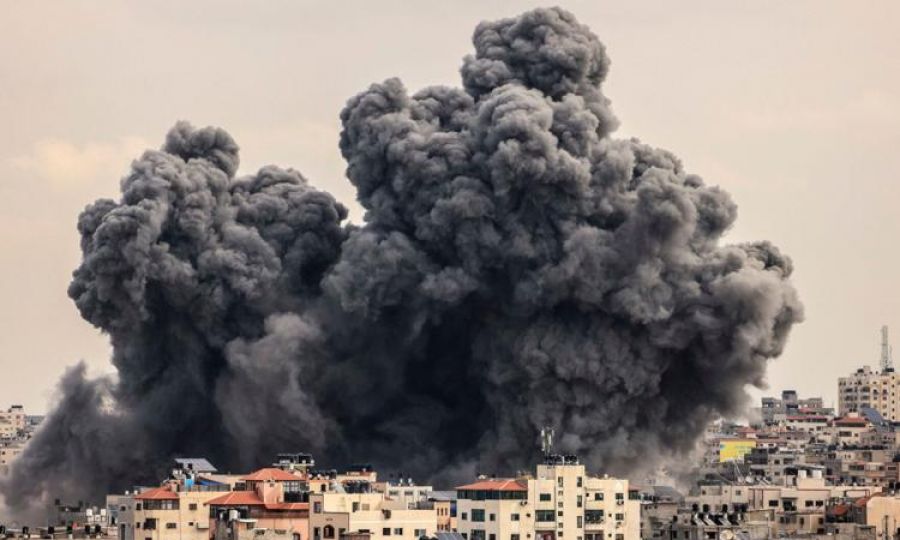
Untold violence has been un-leashed in the Middle East.
We have no way of knowing where it will lead.
This four-part series by the author of ‘The Mighty Heart in Action’ investigates how the power of the heart can respond to this crisis
Part 1: Violence
What we do have is the knowledge – the evidence – that those involved cannot depend on weaponry for ‘security’.
Lethal weapons may make political leaders, or their military, feel safer. But when they use those weapons, what they unleash on people on either side is shock, terror, threat of retaliation, more violence, and more threat.
In any war, vast numbers of people become instantly vulnerable, and weapons cannot protect them. Thousands of refugees have nowhere to go; minorities are instantly exposed to persecution; health facilities are overwhelmed and unable to cope; women with children need protection; the wounded need in-depth care to recover; thousands have lost their homes and need shelter; orphaned children need reliable adult protection. Violence follows violence. And even if people survive, they have no security, only damage and fear – and in many cases the terror that will stay with them all their lives.
Is there an alternative to violence following violence?
The main alternative is clearly negotiation. But once destruction has taken place it provokes more violence, and many lives will be lost before leaders will come to the table.
Then peace building may be the answer put forward. Those involved in this extremely difficult work know only too well how long it takes, how many almost insuperable problems it reveals, problems that may have been simmering beneath the surface of a society for decades. They know that one violent incident can, in an hour, put back their progress by months, even years.
Trying to re-build communication and co-operation, after extreme violence has taken place, can test the skills of the most experienced and devoted peace builders. Violent individuals can wreck a carefully constructed peace agreement in minutes. Separation of warring factions can work initially, but quite soon parties will observe any advantages their former enemies have may have gained – and invade or otherwise wreck agreements that took months or years to negotiate.
So what else is there? What can give security, restore a sense of safety, of permanence, of being able to trust – trust in others, in our community, trust even in our future? In our experience as peace negotiators over years, the best answer lies in the power of the heart.
“The heart ??” I hear you say. What on earth can the heart do in the bloody wrath of war?
The human heart has VAST powers, powers immediately needed in chaos and violence, including:
- the heart’s power to THINK and ACT FAST – with such insight and speed that it saves lives
- the heart can stay entirely present in a crisis, in micro-seconds knowing exactly what’s needed
- the heart has a unique capacity to listen deeply, so to understand conflict at a deep enough level to produce accurate solutions
- we forget that the heart is an artist, able instantly to imagine, envisage the future, construct, design
- and the heart can beam out compassion, love, and care in vast quantities, especially during crises when humans are tense and unimaginative.
Since your heart is aware what’s really going on, that knowledge can be pivotal when the chips are down, for instance when a fight starts. Your heart is not afraid. That’s how the heart can deal precisely and effectively with violence, rage, pain or indifference. Your heart is the best first responder.
A short story of the heart about Aikido Master Terry Dobson
Related by Ram Das in his book ‘How can I help?’ (Ram Das and Paul Gorman)
The train clanked and rattled through the suburbs of Tokyo on a drowsy spring afternoon. Suddenly the afternoon quiet was shattered by a man bellowing violent, incomprehensible curses. He staggered into our car – big, drunk, and dirty.
Screaming, he swung at a woman holding a baby. The blow sent her spinning into the laps of an elderly couple. The train lurched ahead, the passengers frozen with fear. I stood up. I was young then, 20 years ago, and in pretty good shape. I’d been putting in a solid eight hours of aikido training nearly every day for the past three years. This is it! I said to myself, getting to my feet. Seeing me stand up, the drunk recognized a chance to focus his rage. “Aha!” He roared. “A foreigner! You need a lesson in Japanese manners!” I gave him a slow look of disgust. I pursed my lips and blew him an insolent kiss. “All right!” he hollered. “You’re gonna get a lesson.” He gathered himself for a rush at me.
A split second before he could move, someone shouted “Hey!” It was ear-splitting.
I remember the strangely joyous, lilting quality of it – “Hey!” I wheeled to my left; the drunk spun to his right. We both stared down at a little old Japanese. He must have been well into his seventies, this tiny gentleman, sitting there immaculate in his kimono.
“C’mere,” he said in an easy vernacular, beckoning to the drunk. “C’mere and talk with me.” He waved his hand lightly. “Why the hell should I talk to you?” The drunk now had his back to me. The old man continued to beam at the labourer. “What’cha been drinkin’?” he asked, his eyes sparkling with interest. “I been drinkin’ sake,” the labourer bellowed back, “and it’s none of your business!”
“Ok, that’s wonderful,” the old man said, “You see, I love sake too. Every night, me and my wife (she’s 76, you know), we warm up a little bottle of sake and take it out into the garden, by the old persimmon tree. …!” He looked up at the labourer, eyes twinkling. As he struggled to follow the old man’s conversation, the drunk’s face began to soften.
His fists slowly unclenched. “Yeah,” he said. “I love persimmons too…” His voice trailed off. “Yes,” said the old man, smiling, “and I’m sure you have a wonderful wife.” “No,” replied the labourer. “My wife died.” Very gently, swaying with the motion of the train, the big man began to sob. “I don’t got no wife, I don’t got no home, I don’t got no job. I am so ashamed.” Tears rolled down his cheeks; a spasm of despair rippled through his body. Then the train arrived at my stop.
As the doors opened, I heard the old man cluck sympathetically. “My, my,” he said, “that is a difficult predicament, indeed. Sit down here and tell me about it.” I turned my head for one last look. The labourer was sprawled on the seat, his head in the old man’s lap. The old man was softly stroking the filthy, matted hair. As the train pulled away, I sat down on a bench. I had just seen aikido tried in combat, and the essence of it was love.
Now for some of the physical aspects of the heart:
It will help you to know a few things about the heart – partly because it isn’t what you think it is, and partly because it will give you a perspective on all the issues of this course.
We were all taught to think of the heart as a pump – which is deeply misleading because it makes you think of it as something hard, mechanical, unfeeling, unthinking. None of that is true. It is very soft and supple and flexible. It is regarded worldwide as the source of feeling, and of love. It has the intelligence to change the rate with which it sends blood through your body according to need, slowing down hugely when you’re asleep and speeding up dramatically if you’re running a race or dealing with stress.
It remembers things too. There are many stories of heart transplants which have had surprising consequences. A young woman, a passionate vegetarian and animal lover, received the heart of a young man killed in a motorcycle accident. When she came out of hospital and was being driven home, she insisted that her parents stopped the car at a drive through MacDonalds as her craving for a hamburger was so intense. She later discovered that the young man had loved hamburgers.
The sound of the heartbeat echoes in every cell of the body. Each organ vibrates to a different frequency but, like an orchestra with a conductor, they all base what they are doing on the beat of the heart. If a heart loses its rhythm, then all the other organs are immediately distressed. So, what happens in the heart affects the whole body profoundly – and can profoundly affect the world we live in.
(Image Reuters)