Part 2: Heart Power in a crisis
What this means is that we all have an organ within us that has vital power, and essential knowledge, available in the instant.
Heart power can be used with great effectiveness in daily life. But most of us are not aware of it, in the sense that we spend much of our time being driven by our thoughts, our calculations, our fears. When we can touch into the heart, our actions turn out to be very different, because we have access to a different source of strength. That source of strength is beyond calculation; it is generous, fast, unselfish, and light. It is light, meaning that it is not worked out by your brain, not calculated to have an effect, it is spontaneous.
Here are some examples – learned from people in life and death situations – of what the heart can actually do in a crisis:
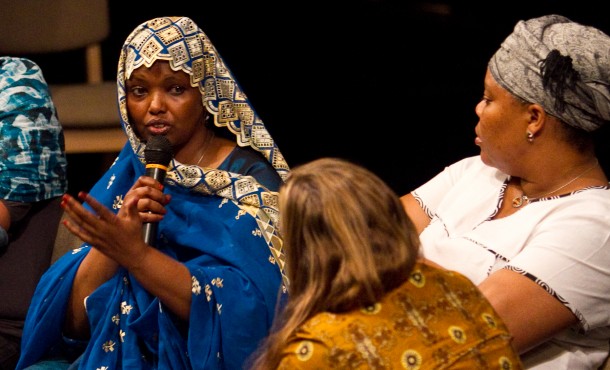
The heart deals immediately and instinctively with risk. In Kenya, when post-election violence was raging in 2007, Dekha Ibrahim Abdi used women’s organisations to help in plotting not only the ‘hot spots’ of the violence but also the ‘cold spots’ – to know where people were dying and where they were running for protection. They then developed strategies for each spot. This brought the violence under control in three weeks.
Heart intelligence can reduce violence. In Northern Ireland, when religious sectarian killings in Belfast had escalated to crisis levels in 1974, Betty Williams and Mairead Maguire co-founded the Community for Peace People, and mobilized over 10,000 Catholic and Protestant women to march and advocate for peace from 1974 – 1980, risking their lives to do so, day after day. Steadily and consistently, their hearts were calming the violence – for which they subsequently won the Nobel Peace Prize.
The heart understands the pain of the ‘other’. In the Philippines, Irene Morada Santiago learned how to negotiate peace between Muslim separatists and the Philippines government. She could do this because she felt, in her heart, what each was going through: not only could she observe it, but she could also feel the angst, the pain. Her resilience made her one of the first women in the world to lead a peace negotiating panel, and she went on to chair the implementation of a major peace agreement.
These may all seem distant examples from what you might call ‘the world stage’. But if you keep your eyes, ears and heart open, you’ll notice the very different quality of connection that can sometimes take place – even in a family argument. You may observe one party leaning forward and really listening to the other. Then, having become curious, that same person may gently ask another question. This means that the other person begins to feel heard and is encouraged to reveal more of their feelings. A real conversation, a sharing of depth, can begin. The tempo slows down.
Voices become softer and clearer.
This is the heart at work.
If your child is lucky enough to be taught in a school with wise experienced teachers, he or she will see how those teachers can calm an argument, can stop a fight, can turn the threat of violence into laughter.
The heart anticipates violence and prevents it. How? Electro-magnetic waves from the heart can be felt a long way outside the body. Machines can pick up heart waves about twelve feet away from the body; humans can pick them up much further off. These waves contain information – in fact it is more accurate to say they are information. One heart can respond to another by falling into step with its rhythm and that forms a connection between two people which they will both feel, even if they can’t explain it.
The instinct of the heart is to connect, understand, perceive – rather than to judge. Threats do not work when the heart is open. The heart is not interested in being right…. but the heart is very interested in connection.
Image – Dekha Ibrahim Abdi at EMU